When Emotions Cost Your Business: A Simple Mindset for SME Growth
When Emotions Cost Your Business: A Simple Mindset for SME Growth

The Hidden Cost of Emotional Decisions
As an SME owner, you make decisions all day. Under pressure, it’s easy to react emotionally—but these small moments can be costly.
Just 2–3 emotional decisions per month can reduce profitability by up to 15–30%. It’s a hidden cost many businesses overlook.
Monk Mindset: Calm Leaders Grow Faster
The idea is simple:
Calm Mind → Clear Thinking → Better Decisions → Higher Profit
When leaders shift from reacting impulsively to responding mindfully, they gain greater clarity and strengthen trust within their teams.
Research from Harvard Business Review shows that organizations led by emotionally intelligent and mindful leaders can achieve up to 23% higher profitability compared to others.
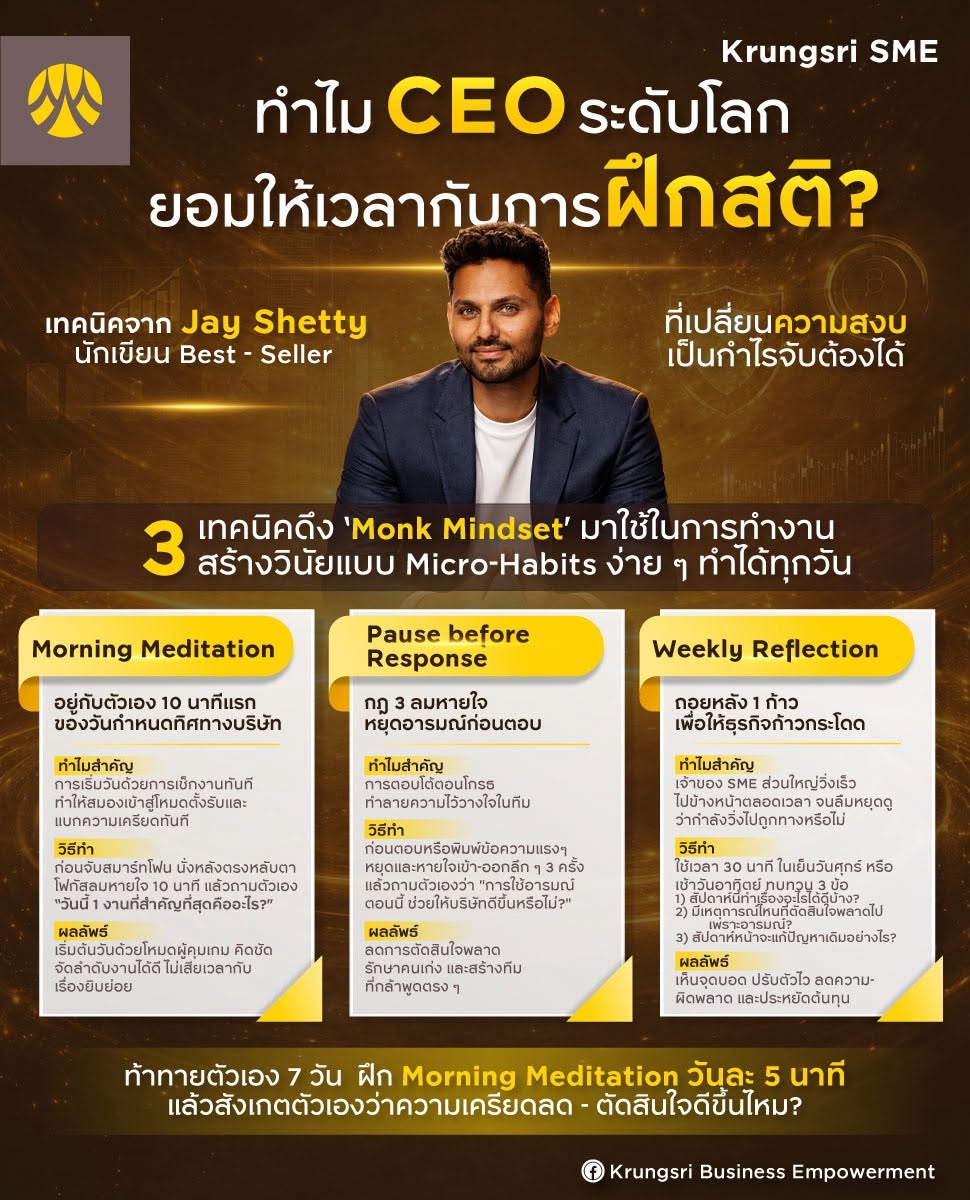
Lessons from Global and Thai Leaders: Mindfulness as a Strategic Advantage
This concept is not theoretical—it is actively practiced by top leaders worldwide:
- Ray Dalio (Founder, Bridgewater Associates)
Attributes his success to Transcendental Meditation, which helps him overcome ego and remain calm during market volatility.
-Marc Benioff (CEO, Salesforce)
Integrates Zen principles into corporate culture, even building meditation rooms on every floor of Salesforce Tower—believing that innovation comes from a calm and focused mind.
-Suphajee Suthumpun (Former Group CEO, Dusit Thani / Former Minister of Commerce, Thailand)
A leader who has guided multiple organizations through crises, emphasizing mindfulness, focus, and conscious decision-making as the foundation for stability and resilience.
3 Practical Techniques to Apply Monk Mindset at Work
Mindfulness for executives doesn’t require rituals—it’s about building simple daily micro-habits:
1. Morning Meditation: 10 Minutes to Set the Direction for the Entire Business
Why it matters:
Checking emails immediately after waking up forces your brain into reactive mode, loading stress from the start.
How to do it:
Before touching your phone, spend 10 minutes sitting upright with your eyes closed, focusing on your breathing. Then ask yourself:
“What is the ONE high-impact task I must accomplish today?”
Business impact:
- Start the day proactively
- Improve focus and prioritization
- Avoid getting lost in low-value tasks
2. Pause Before Response: The 3-Breath Rule
Why it matters:
When mistakes happen, leaders often react instantly—risking trust and team morale.
How to do it:
Create a pause between trigger and response. Before sending a harsh message, stop and take 3 deep breaths, then ask:
“Will reacting emotionally improve the business?”
Business impact:
- Reduce decision errors by up to 60%
- Maintain team trust and motivation
- Encourage open communication and long-term sales growth
3. Weekly Reflection: Step Back to Move Forward Faster
Why it matters:
Many SME owners move forward constantly without checking if they are heading in the right direction.
How to do it:
Set aside 30 minutes weekly (Friday evening or Sunday morning) to reflect:
- What went exceptionally well this week?
- Where did I make emotionally driven decisions?
- How will I improve next week?
Business impact:
- Identify blind spots
- Adapt strategies faster
- Avoid repeated mistakes and reduce costs
Common Pitfalls to Avoid
While powerful, applying Monk Mindset requires awareness:
- Consistency is key
- Results take 21–90 days. Start with yourself, then scale to your team.
- Calm but decisive
- Mindfulness is not weakness. Communicate clearly: “Calm, but not soft.”
- Progress over perfection
- Emotional reactions will still happen—that’s normal. Focus on improvement, not perfection.
A Sustainable Implementation Plan
You don’t need to start everything at once:
- Week 1–2:
- Begin with 5 minutes of morning meditation
- Week 3–4:
- Add “Pause Before Response” for emails and messages
- (Use reminders like: “Breathe before replying”)
- Week 5 onward:
- Start Weekly Reflection (15 minutes)
After 90 days, these habits will become automatic.
The True Mark of Leadership
Great leaders are not those who never feel stress—
they are those who recognize it and can quickly return to a calm and centered state.
3 Key Takeaways
- Calmness = Clarity
- A calm mind leads to better decisions
- Mindfulness ≠ Weakness
- Pausing before reacting is a sign of strength
- Progress > Perfection
- Focus on improving every day
7-Day Challenge
Start with just 5 minutes of morning meditation for 7 consecutive days.
Observe whether your stress levels decrease and your decision-making improves.
Free Download: Monk Mindset Checklist for Executives
Access your free checklist in the comment section below.
Download, print, place it on your desk—and start building your mindful leadership habit today.
https://bit.ly/KS_MonkMindsetAction
#KrungsriSME #KrungsriBusinessEmpowerment #MonkMindset #JayShetty
 +66 2 626 2626
  08:30-17:30 | Mon-Fri
 krungsribusinesslink@krungsri.com
  Krungsri Business Empowerment


Share